We earn a commission if you buy through our links, at no extra cost to you.
Best Gazebos for Snow and Cold Weather (2026)
What gazebo snow and wind ratings really mean, why one Sunjoy chart conflicts with its manual, and how to handle snow, winter covers and wind.
At a glance
For snow country, choose the Backyard Discovery Barrington 20x12 or the Backyard Discovery Barrington 12x12: both list a 30 inch snow rating when anchored per the manual. The Sojag Genova 10x14 has an aluminum frame, but its maker says to remove snow from the roof.
A gazebo roof in January faces a job that a patio umbrella never does: it has to carry snow, shed ice and stand up to wind that arrives with little warning. Makers describe their gazebos as “4-season,” “all-season” or “weather resistant,” but those are marketing words, and each company draws the line in a different place.
This guide sorts out what the makers actually publish. It draws on their product pages and manuals, ShelterLogic’s winter cover page and the National Weather Service. Where a maker gives no number, we give none. We compare published specifications and make no claims from personal use. No gazebo makes a winter storm safe to sit through.
What a Snow or Wind Rating Really Tells You
Read three things before you trust a number.
The condition. Backyard Discovery’s rating pages carry an asterisk: the product must be anchored as specified in the instruction manual. So the figure belongs to a structure that was built level, on a proper base and anchored per the manual, not to a gazebo set on a lawn.
The source. These are the maker’s own claims. None of our sources include an independent measurement of these gazebos, so treat the numbers as claims.
The wind picture. The National Weather Service says that when winds are sustained at 40 to 50 mph, isolated wind damage is possible, and that straight-line winds in strong thunderstorms can exceed 100 mph. Set that against a 50 mph chart rating or a 100 mph claim, and anchoring and a close watch on the forecast matter more than any one number.
Where a maker publishes nothing, nobody outside the factory knows. That is the case for the Sunjoy Helena 11x13, so we leave it out of the recommendations below. See our Helena profile for what its manual does say.
Backyard Discovery Barrington 20x12: The Highest Published Figure
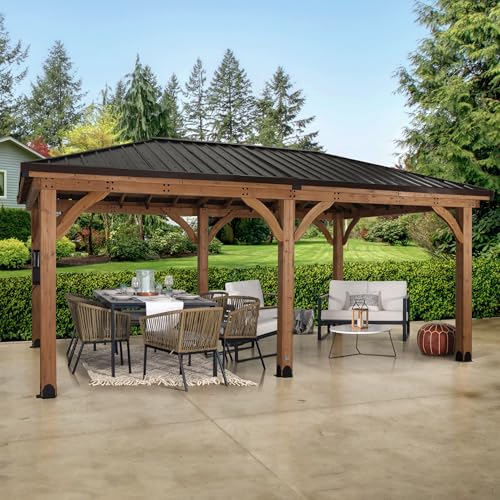
A large cedar gazebo with a steel hip roof and a published rating of 12,700 lb or 30 in. of snow and 100 mph winds when anchored per the manual.
The Barrington 20x12 publishes the highest numbers in our lineup: up to 12,700 pounds or 30 inches of snow load and winds up to 100 mph, with the maker’s anchoring condition. The roof is 29-gauge galvanized steel in a hip shape, which slopes on all four sides so snow can slide off in any direction. The posts are 6 x 6 inch cedar.
The manual is specific about the base. It says to start with square and level footings, a concrete pad or a deck, and the parts list includes concrete anchors. Hardware for a wood deck is not included, and the deck needs ample structural support. On a snowy site the base matters twice, because a settled or unlevel pad changes how the roof loads, and Backyard Discovery’s warranty does not cover installation on uneven, unlevel or soft ground. The warranty also excludes storm damage.
It is a heavy kit, about 1,182 lb in eight boxes. See the Barrington 20x12 profile for the details.
Backyard Discovery Barrington 12x12: The Same Idea in a Smaller Footprint
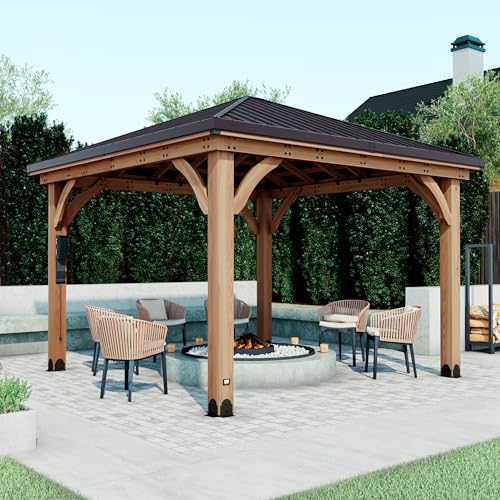
A 12 x 12 ft cedar gazebo with a steel hip roof and a published rating of 7,500 lb or 30 in. of snow and 100 mph winds when anchored per the manual.
The 12x12 shares the 20x12’s hip roof and cedar frame and lists up to 7,500 pounds or 30 inches of snow load and winds up to 100 mph, again with the anchoring condition. Backyard Discovery’s page says snow can weigh up to 13 pounds per square foot and that thin metal roofs can fail under it, which is the company’s case for a heavy-gauge steel roof. That is a marketing claim, not an independent figure.
For most buyers in snowy regions this is the practical option: 12 feet square fits most yards, and the published snow figure matches the larger model. The listed weight is 793.67 lb in five boxes. Read the Barrington 12x12 profile before you pour a base, and note that we rely on the 20x12 manual for deck and concrete details, so confirm them in the manual for your model.
Sunjoy Ion 13x13 Octagon Gazebo: When the Chart and the Manual Disagree
The Ion is where the fine print earns its keep. Sunjoy’s spec chart lists a 50 mph wind rating and a snow load capacity of 3,500 lb for the entire roof. The assembly manual then says the gazebo “is intended for decorative and sunshade purposes only, and it is not designed to withstand harsh weather, including high winds, rain, and snow.”
Both statements come from Sunjoy, and we cannot reconcile them. The cautious reading is that the Ion suits ordinary mild-weather use and that the chart figures should not be relied on for heavy snow. Note too that the chart’s 50 mph figure sits right where the National Weather Service says isolated wind damage becomes possible. The official page shows the black-roof version, and the Amazon listing is the brown-roof version of the same octagon.
If your winters are mild and the design appeals, anchor it as the manual says (Sunjoy does not provide anchors for wood or concrete) and keep the roof clear. If snow is routine, look at the Barringtons above. Our Ion profile has the rest.
Sojag Genova 10x14: Aluminum Frame, Snow Removal Required
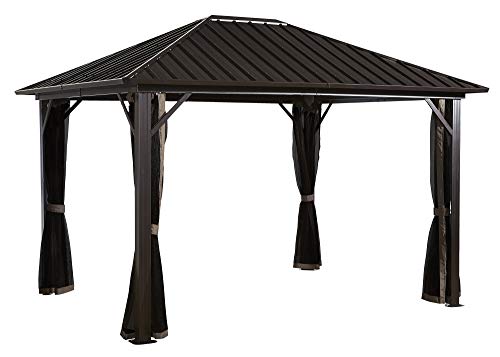
An aluminum-frame hardtop that Sojag calls 4-season, with a galvanized steel roof and mosquito netting; its maker says to remove snow from the roof.
Sojag calls the Genova a 4-season gazebo, with a powder-coated aluminum frame and galvanized steel roof. ShelterLogic’s product page, though, says any accumulation of snow should always be removed from the roof. ShelterLogic gives no snow or wind rating that we can attribute to the 10 x 14 size, so we publish none.
The Genova’s strengths in cold climates are practical ones. The aluminum frame needs no staining or sealing, and the included mosquito netting can come off for winter if the maker’s instructions say so. The warranty is one year limited. See the Genova profile.
Removing Snow From a Gazebo Roof
ShelterLogic is blunt: any accumulation of snow should always be removed from the roof. For any gazebo, a few habits follow.
- Clear snow as it builds up, not after a long storm. Use a soft tool that will not scratch the finish or the coating.
- Stay out from under the roof while you clear it. Snow and ice can slide off the roof at once.
- Do not climb on the roof or use it as a platform.
- Check bolts and fasteners after heavy snow, since Sunjoy’s manuals ask owners to check nuts and bolts periodically.
- Touch up scratches. Sunjoy says surface rust appears once its coating is scratched and recommends immediate touch-up with rust-inhibiting paint.
None of this replaces the manual for your model.
Winter Covers
ShelterLogic sells universal winter covers made of ultra-strong polyethylene for Sojag gazebos, sold without the gazebo. It says they protect a metal gazebo from snow, ice and rough weather, make it easier to remove ice, snow or debris, and can turn the gazebo into a storage space for patio furniture. It suggests two people for installation, a stepladder, and weights and eyelets for securing excess material at the bottom.
Two cautions. Covers come in specific sizes, so confirm the cover fits your gazebo, particularly the Genova. And a cover is for a gazebo that is not in use: never run a grill, heater or fire pit under a gazebo that is covered or enclosed.
Wind, Anchoring and Common Sense
Anchor every gazebo as its manual directs. Backyard Discovery’s Barrington 20x12 manual includes concrete anchors but not deck hardware, and Sunjoy’s manuals say anchors are not provided. On a deck, have a contractor confirm the framing.
Check local rules, too. Sunjoy’s manual tells owners to check municipal codes before installing, and a roofed structure can trigger permit or setback rules or homeowners association approval.
And do not shelter under a gazebo. The National Weather Service says high winds can blow objects around and pose a significant threat to your safety. For the full lineup, see the best gazebos of 2026.
Sources
- Backyard Discovery 20x12 Barrington Gazebo (official product page)
- Backyard Discovery Barrington 20x12 owner’s manual (PDF)
- Backyard Discovery 12x12 Barrington Gazebo (official product page)
- Backyard Discovery General Information & Safety Booklet (PDF)
- Sunjoy Ion Octagon Wood Gazebo 13x13 (official product page, black-roof version)
- Sunjoy Ion 13x13 gazebo instruction manual (PDF)
- Sojag Genova 10x14 product page (ShelterLogic)
- ShelterLogic: Gazebo winter covers
- National Weather Service: Wind safety
Frequently asked questions
Can a gazebo stay up all winter in snow country?
Some makers say so, with conditions. Backyard Discovery publishes up to 30 inches of snow load for its Barrington 20x12 and 12x12 when anchored as the manual specifies. Sojag calls the Genova a 4-season gazebo, but ShelterLogic says any accumulation of snow should always be removed from the roof. Check the manual for your model.
How much snow can a gazebo roof hold?
Only the maker can say for its own model. Backyard Discovery lists 12,700 lb or 30 inches for the Barrington 20x12 and 7,500 lb or 30 inches for the 12x12, anchored per the manual. Sunjoy's chart lists 3,500 lb for the Ion, but its manual says the gazebo is not designed for harsh weather. Sojag gives no figure we can tie to the Genova.
Should I remove snow from my gazebo roof?
ShelterLogic says any accumulation of snow should always be removed from the roof of the Sojag Genova, and clearing snow is sensible for any gazebo. Use a soft tool that will not scratch the finish and stay out from under the roof while you work.
Do winter gazebo covers work?
ShelterLogic sells polyethylene winter covers for Sojag gazebos and says they protect a metal gazebo from snow and ice and make it easier to remove ice, snow or debris. Covers are sold in specific sizes and are sold without the gazebo, so confirm the fit for your model before you order.
Is a gazebo safe to stand under in high wind?
No rating makes it so. The National Weather Service says high winds can blow objects around and pose a significant threat to your safety. Do not shelter under a gazebo during severe weather.
What does the asterisk on a Pro-Tect rating mean?
Backyard Discovery's pages say the product must be anchored as specified in the instruction manual. The load and wind numbers are the maker's figures for a structure built and anchored that way, not a promise about any particular storm.