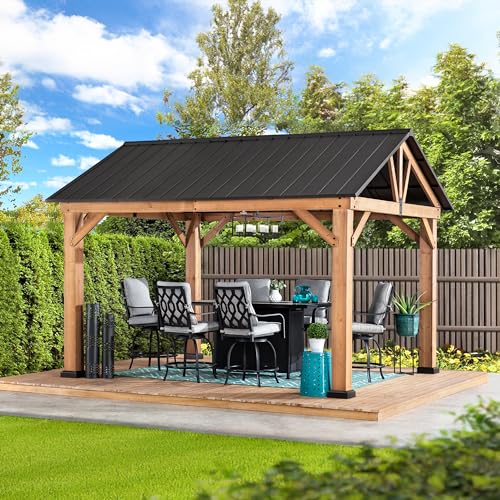
The Sunjoy Helena is an 11 x 13 ft gable-roof gazebo with a cedar wood frame and a powder-coated steel roof. It suits buyers who want a classic backyard pavilion shape with a ceiling hook for a chandelier or string lights, delivered in two boxes and assembled at home. We place it fifth in our 2026 gazebo ranking because the design and footprint are appealing, but the maker publishes no snow or wind figure for it and its own manual is cautious about weather. That makes it a good fit for the right yard and a poor fit for others.
Every specification below comes from Sunjoy’s official product page and its assembly manual for item A102008001. We add no numbers from memory, and where Sunjoy gives no figure, we give none. The analysis and opinions are ours.
What Sunjoy Says About the Helena
According to Sunjoy, the Helena is a “post-to-post size 10x12” gazebo built by a ready-to-assemble outdoor structure maker. It describes a cedar wood frame under a sturdy powder-coated steel pavilion roof, and a classic gable design that provides airflow while keeping occasional inclement weather at bay. The page also points to a built-in ceiling hook for suspending a chandelier and promises straightforward assembly instructions.
The feature chart on the same page lists the following:
- Overall size: 13.1 ft long x 11 ft wide x 9.6 ft high.
- Roof size: 11 ft x 13 ft.
- Base size: 10 ft x 12 ft.
- Internal post-to-post size: 9.2 ft wide x 11.1 ft long x 6.5 ft high.
- Entry height: 6.5 ft.
- Material: steel and wood.
- Product weight: 449.74 lb.
- Packages: 2 boxes.
The name “11x13” refers to the roof, and the 10 x 12 ft base is the footprint of the posts. Those are different numbers, and mixing them up is an easy mistake when planning a deck or pad. If you are marking out a space, use the overall 13.1 x 11 ft figure and then add the clearance the manual asks for.
Sunjoy’s manual says to place the gazebo on flat, horizontal ground, at least 6 ft away from any structures or obstructions such as fences, garages, houses, overhanging branches, laundry lines or electrical wires. It also says not to place the product underneath electrical lines. So a 13.1 x 11 ft gazebo needs a much larger clear area than its own outline, roughly the footprint plus a 6 ft margin on every side. In a small, narrow yard, that clearance can rule the Helena out, and it is better to find that out before you order.
The manual also asks you to check with your local governing authority and municipal codes about installing structures before assembly. In practice, that means checking whether your city, county or homeowners association requires a permit or a setback for a freestanding structure of this size. We cannot tell you what your local rules say, and the manual does not either.
Roof and Frame: Cedar Wood and Powder-Coated Steel
The Helena combines two materials. The frame is cedar wood, which Sunjoy presents as part of its all-season appeal, and the roof is powder-coated steel in a gable shape. A gable roof has two sloping sides that meet at a ridge, which lets rain run off both sides and leaves the ends open to airflow. Sunjoy says the design provides “just the right amount of airflow.”
Cedar is a wood many buyers choose because it looks warm and is commonly used outdoors, but it is still wood, and it needs attention. Sunjoy’s manual tells you not to overtorque the bolts when assembling the wooden parts, to avoid splitting the wood, and to check all nuts and bolts periodically to keep them tight. Wood moves as it dries and gets wet, so a yearly walk-around with a wrench is a reasonable habit. The manual does not publish a staining or sealing schedule that we could find, so check the instructions that come with your unit and ask Sunjoy customer care if you want a finish recommendation.
Compared with aluminum-framed gazebos such as the Sojag Genova 10x14, a cedar frame offers a more traditional look and more visible texture, while the aluminum frame is the lower-maintenance choice. Which matters more is a personal call.
Weather: Read the Manual Before You Buy
This is the section that matters most for the Helena. Sunjoy’s product page says the gazebo is made for enjoying “all four seasons” under the roof and that the gable design keeps “occasional inclement weather” at bay. Its assembly manual is more cautious. It states that the gazebo “is intended for decorative and sunshade purposes only, and it is not designed to withstand harsh weather, including high winds, rain, and snow.”
Those two statements can be read together: the gazebo is meant for covered outdoor time in ordinary conditions, not for exposed sites or severe storms. Unlike some competitors, Sunjoy does not publish a snow-load or wind-speed rating for the Helena, so we do not either. If you live somewhere with heavy snowfall or frequent high winds, a gazebo with a published rating and stated conditions is a better starting point. Our Barrington 12x12 profile covers one that quotes Pro-Tect figures, and those figures apply only when the structure is installed and anchored as its manual directs.
The National Weather Service’s wind guidance, which we also read, is a useful reminder that wind can move and damage light outdoor structures, and that no manufacturer rating makes a gazebo a shelter during a storm. Do not shelter in any gazebo during severe weather.
Anchoring and the Ground Under It
Sunjoy’s manual says the gazebo is not part of a building or house structure and “is to be anchored onto the ground for added safety.” It also says not to assemble it onto soil or earth, and that it is best to build it onto a wooden deck or concrete for stability. If you build it on a wooden deck, the manual says to make sure the deck has a strong foundation, and it advises using appropriate floor plugs, which are not provided, to anchor it to the wood or concrete.
Three practical points follow from that:
- Budget for anchors. The box does not include the hardware that fixes the posts to a deck or slab. Pick anchors suited to your surface and follow the Helena manual’s guidance.
- Confirm your deck. A 450 lb structure, plus whatever wind pushes on it, is a load. Have a contractor confirm that the deck framing and fastening can carry and hold it. The American Wood Council’s deck construction guide (DCA 6) is a common reference for how residential decks are framed, but it is a guide for builders, not a gazebo rating.
- Check for utilities. The manual says to check for underground utilities before digging or driving stakes into the ground.
If you want a gazebo for a deck, see our guide to gazebos for decks for how weight, anchoring and footprint interact.
Assembly
The Helena arrives in two boxes and weighs 449.74 lb in total, so plan on at least two adults. The manual says some structures require two or more people to install, that assembly must be carried out by adults only, and that you should wear safety glasses and gloves where parts have sharp edges. It also asks you to keep children and pets away during assembly and to compare parts with the packing list before you start. If something is missing, the manual lists a toll-free customer service number and says not to attempt assembly with missing parts.
The tools for assembly are not included, so check the manual’s list. Keep the original packaging, as the manual advises, if you may want to store or move the gazebo later.
Fire and Lighting
Sunjoy’s manual says not to light any fires inside or near the product, and not to hang heavy weights from the roof frame. The ceiling hook is meant for a light fixture or similar, so keep to what the manual allows. If you plan to add lighting that needs wiring, or an outdoor outlet, hire a licensed electrician; GFCI protection and local code apply, and it is not a do-it-yourself job. Battery or solar lights avoid the question altogether.
Do not put a grill, fire pit or patio heater under the Helena. If grilling is the goal, see our guide to grill gazebos, and remember that a grill’s own manual decides the clearances to anything combustible.
Pros and Cons
Pros
- A traditional cedar and steel gable look with a ceiling hook.
- An 11 x 13 ft roof, with a 6.5 ft entry height, gives room for a small dining set or lounge seating under the roof.
- Two-box delivery and a printed manual with customer service by phone.
- Sunjoy specifies exact dimensions, which makes planning a pad or deck simpler.
Cons
- No snow or wind rating, and a manual that warns against harsh weather.
- Anchors for decks or concrete are not provided.
- A large clearance requirement of at least 6 ft from other structures.
- Cedar needs periodic attention and bolt checks.
- Heavy and best handled by two or more people.
Who It Is For
The Helena suits a homeowner with a flat, sheltered patio or a well-built deck who wants shade and a classic gable look for summer and early fall evenings. It is a reasonable choice for dining or conversation seating where wind exposure is modest and snow is not a regular concern.
It is not the model to pick if you need a published snow or wind rating, if the gazebo will sit on bare lawn, or if the plan includes a grill. Those buyers should compare the Pro-Tect-rated Backyard Discovery models or the aluminum-framed Sojag options in our full ranking.
Maintenance and Seasonal Care
Because the manual calls the product a decorative and sunshade structure, treat it that way: check bolts periodically, keep heavy objects off the roof frame, do not climb on the roof, and watch the weather. Sunjoy also tells buyers to keep a minimum distance of 10 ft between gazebos if you place more than one. Replacement or repair of parts should be done by a qualified technician, according to the manual.
If heavy wind or snow is in the forecast, a cautious owner will take the roof load seriously even without a published figure. We cannot say what snow load the Helena can carry, because the maker does not, so the conservative approach is to keep the roof clear and avoid relying on it in bad weather.
Alternatives on This Site
Browse all of them together in our 2026 gazebo comparison.
Our Take
The Helena is an attractive, fairly roomy gable gazebo whose strengths are its look and its dimensions, and whose limits are spelled out by the maker. If your yard is calm and your ground is solid, it is worth a look. Check the item number, plan for anchors and read the manual’s weather language before you decide.
Sources