We earn a commission if you buy through our links, at no extra cost to you.
Best Grill Gazebos: Dakota vs Saxony and Clearances
Choosing a gazebo for a grill: metal Sojag Dakota or cedar Backyard Discovery Saxony, why your grill manual sets clearances, and what never goes under a roof.
At a glance
For a metal frame and roof over a grill, the Sojag Dakota 6x8 Grill Gazebo is the compact pick. For a cedar frame with bar tops and outlets, choose the Backyard Discovery Saxony Grill Gazebo. In both cases, your grill's manual sets the clearances, and a grill never belongs under a regular wood gazebo.
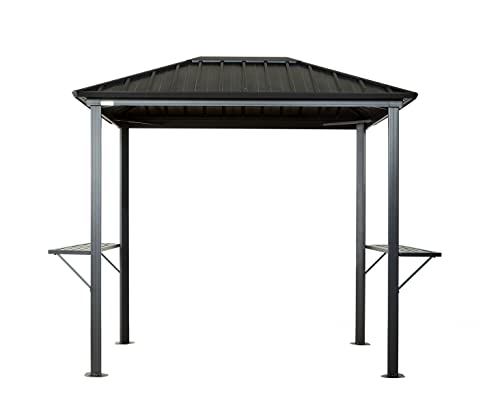
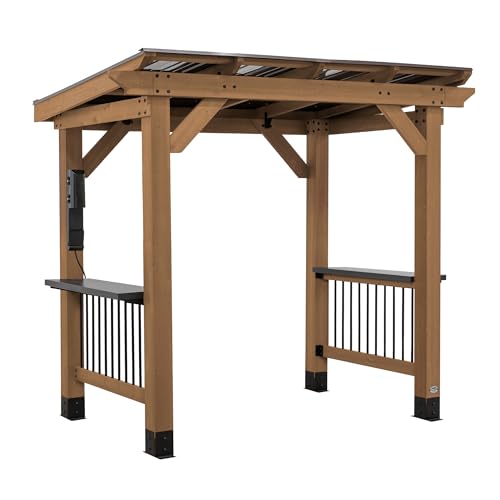
Searches for a “gazebo for grill” or a “BBQ gazebo for an outdoor grill” tend to mix up two very different things: a structure sold specifically for grilling, and an ordinary patio gazebo that happens to have a roof. The first is built around the idea of a grill underneath. The second is not. This guide explains the difference, why your grill’s manual matters more than anything on a gazebo’s product page, and how two grill gazebos on our site compare: the metal Sojag Dakota and the cedar Backyard Discovery Saxony.
We have not used these products. Everything below comes from the makers’ own pages and manuals, plus one published grill-clearance example, and the comparisons are our own reading of those documents. Nothing here promises that a structure or a setup is safe; it is a buying guide, not an installation guide.
Dedicated Grill Gazebo vs Regular Gazebo
A grill gazebo is sold for cooking. The two models below are both described by their makers as places to grill: ShelterLogic’s page for the Sojag Dakota calls it a grill gazebo whose roof protects the grill and the cook, and Backyard Discovery describes the Saxony as a BBQ gazebo and an outdoor cook station. They are also small and open-sided, with shelves or bar tops at working height.
A regular gazebo is sold for shade, seating and dining. Our Sunjoy Ion profile quotes its manual: the gazebo is intended for decorative and sunshade purposes, and the manual says “Do not light any fires inside or near the product.” Sunjoy’s Helena manual carries the same wording. A charcoal or gas grill is a fire. If a gazebo’s own manual says no fires inside or near it, a grill does not belong there, however big the roof is.
The practical rule: use a grill under a roof only when the structure is sold for grilling and your grill’s manual allows it. Both conditions, not one.
Why Your Grill’s Manual Sets the Clearances
Gazebo makers do not publish one universal distance between a grill and the roof, because grills differ. The distance comes from the grill’s manual. As one attributed example, Wolf’s support page for its outdoor grills says:
- Combustible material should not be within 12 inches of the side or rear of the grill, regardless of how high the material is relative to the grill.
- There is no minimum distance above the grill, because combustible material cannot go over the grill, no matter how high.
- Materials considered combustible are determined by local code.
- Its outdoor grills cannot be installed in any enclosed or covered area with a roof or overhang, including a roof’s eave overhang.
That last point matters. Wolf’s own grills are not meant to go under a roof at all. A freestanding grill from another brand may have different instructions, and that is the point: you cannot read the answer off a gazebo page. Before buying, find your grill’s manual (most makers post them online), look for “clearance to combustible construction” or similar wording, and measure the grill with the lid open.
If the manual allows an overhead structure, it will usually state a minimum height or a noncombustible material requirement. If it says nothing, or says no, treat that as a no. If you cannot decide, ask the grill’s manufacturer, and ask your local building or fire office about code. We cannot tell you whether a particular combination meets either.
Metal vs Cedar: What Combustible Means Here
The two gazebos differ in an obvious way. According to ShelterLogic, the Dakota has an extruded aluminum frame and galvanized steel roof panels. According to Backyard Discovery, the Saxony has a 100% cedar frame under a heavy-duty galvanized steel roof.
Cedar is wood, and wood is generally considered combustible construction. Wolf is explicit that combustible materials are determined by local code. That does not mean a cedar grill gazebo cannot be used with a grill. It means a cedar frame counts as combustible when you read the clearance numbers in your grill manual. The side posts, bar tops and any wood near the cooking surface all have to sit outside the distance the grill maker specifies.
An aluminum and steel structure changes that picture, since neither material burns in the way wood does, but it does not cancel the grill manual. Heat, grease and flare-ups still matter, and the manual may call for distances to any structure. Metal is a reason to ask fewer questions about combustibility. It is not a reason to skip the manual.
Sojag Dakota 6x8 Grill Gazebo: The Compact Metal Pick
A compact all-metal grill gazebo with two side shelves, for a smaller grill and a cook who wants a metal frame and roof.
The Dakota is the smaller, simpler option. ShelterLogic’s pages describe a 6 x 8 ft grill gazebo with two shelves for prep work, condiments or drinks, a galvanized steel roof that the maker says keeps the grill from premature rusting and shades the cook from UV rays, and an open-air design. It comes in black or brown, ships with a hardware kit and instruction manual, and carries a 1-year warranty according to ShelterLogic.
Who it suits: someone with a modest grill who wants a dedicated cooking corner and prefers a frame that will not be wood. Who should look elsewhere: anyone with a large grill, a wide side burner or a grill that needs generous clearance, since the footprint is small and the grill manual’s distances still apply. We do not quote interior dimensions because ShelterLogic’s pages for the two colors lay out their specs differently. Measure your grill against the maker’s drawing.
Details, including what is in the box, are in our Sojag Dakota 6x8 profile.
Backyard Discovery Saxony Grill Gazebo: The Cedar Cook Station
A cedar grill gazebo with two steel bar countertops and built-in outlets, for a larger grill up to 70 inches wide.
The Saxony is the more feature-rich of the two. Backyard Discovery says it accommodates most grills up to 70 inches wide, includes two built-in powder-coated steel bar countertops for prep and serving, and has the company’s PowerPort with three electrical outlets and three USB ports. The roof is heavy-duty galvanized steel. Backyard Discovery states that the Saxony is Pro-Tect rated for roof loads up to 2,100 pounds and winds up to 100 mph, but only when it is installed and anchored as the manual directs. Treat those figures as the maker’s claims, not a promise about any storm.
The warranty is longer than the Dakota’s. Backyard Discovery’s General Information booklet lists 5 years from original purchase for its patio structures, and you should read the booklet for what it covers.
Who it suits: someone who wants a grill-side counter and outlets, with a larger grill. The trade-off is the cedar frame. Because wood is combustible construction, the grill manual’s side and overhead clearances decide whether and how your grill fits, and a 70-inch opening does not automatically mean a 70-inch grill is a good match. Leave margin on each side for the clearance the manual asks for. The Saxony’s PowerPort also needs a power source, and running one is a job for a licensed electrician, who can handle GFCI protection and local code.
More specs are in our Saxony profile.
Never Grill with Curtains Closed
Curtains and side netting are popular gazebo add-ons. ShelterLogic’s knowledge center describes gazebo curtains as a way to add privacy and protect against the elements. Those benefits are real on a patio gazebo, and they are exactly why you should not use curtains around a grill. Wolf’s guidance excludes enclosed and covered areas, and a lit grill needs open air around it. Never use a grill in an enclosed space, and keep curtains, tarps and mosquito netting off a grill gazebo while the grill is lit or still hot.
The same goes for grilling inside a screened or walled structure. If you want a gazebo that you can close up, buy one for seating and keep the grill out in the open on a noncombustible surface, following the grill’s manual.
Comparing the Two
| Sojag Dakota 6x8 | Backyard Discovery Saxony | |
|---|---|---|
| Frame | Extruded aluminum | 100% cedar |
| Roof | Galvanized steel panels | Heavy-duty galvanized steel |
| Counters | Two side shelves | Two powder-coated steel bar tops |
| Outlets | None listed | PowerPort: 3 outlets, 3 USB ports |
| Grill size | Modest grills; measure against the maker’s drawing | Most grills up to 70 in. wide, per the maker |
| Warranty | 1 year (ShelterLogic) | 5 years for patio structures (Backyard Discovery) |
Pick the Dakota if a metal frame, a small footprint and a lower-key setup matter most. Pick the Saxony if you need more counter space, outlets and room for a bigger grill, and you are comfortable working out clearances for a wood frame. If neither fits, a regular gazebo is a seating and shade decision, and our 2026 gazebo ranking covers the eight models on our site. Keep the grill out from under those.
Before You Buy
- Open your grill’s manual and write down the side, rear and overhead clearances to combustible construction.
- Measure the grill with the lid up and any side tables extended, then compare with the maker’s drawings.
- Check local code and any homeowners association rules, since some places restrict grilling under or near structures.
- Anchor the gazebo as its manual directs, on a level, stable surface.
- Have a licensed electrician handle any outlet, lighting or PowerPort wiring.
Want to see how a deck changes the equation? Our guide to gazebos for decks covers weight and anchoring, and the Sunjoy Helena profile shows why a regular cedar gazebo is a shade structure, not a grill shelter.
Sources
- Wolf outdoor grill combustible surface information
- Sojag Dakota 6 x 8 x 8 ft Black Hardtop Grill Gazebo product page (ShelterLogic)
- Backyard Discovery Saxony Grill Gazebo official product page
- Backyard Discovery General Information & Safety Booklet
- Sunjoy Ion 13x13 gazebo instruction manual
- Sunjoy A102008001 gazebo instruction manual
- ShelterLogic: The important benefits of gazebo curtains
Frequently asked questions
Can I put a grill under a regular gazebo?
Not as a rule. Regular gazebos are sold for shade and seating. Sunjoy's Ion manual, for example, says not to light any fires inside or near the product. Avoid putting a grill under a wood-frame gazebo that is not sold for grilling, and remember that the grill's own manual has the final word.
How far does a grill need to be from the gazebo frame and roof?
The grill maker decides, not the gazebo shopper. Wolf, for one, says combustible material should not be within 12 inches of the side or rear of its outdoor grills and that combustible material cannot go over the grill at any height. Other brands publish different numbers, so read your grill manual and measure.
Is a cedar gazebo combustible?
Wood is generally treated as combustible construction, and Wolf notes that what counts as combustible is determined by local code. Treat a cedar frame as combustible when you read your grill manual's clearances, and ask your local building or fire office if you are unsure.
Can I close the curtains or add side panels while grilling?
No. Never use a grill in an enclosed space. Wolf lists enclosed or covered areas, such as a garage, shed or breezeway, among the places where its outdoor grills must not be placed. Take curtains, tarps and netting off the sides around a lit grill.
What size grill fits in the Saxony?
Backyard Discovery says the Saxony accommodates most grills up to 70 inches wide. That is the maker's general figure, so compare your grill's full dimensions, including side shelves and lid, with the opening before you buy.
Who should wire the outlets or lighting?
A licensed electrician. The Saxony's PowerPort is built into the structure, but any new outlet or lighting run near a grill involves GFCI protection and local code, which is not a do-it-yourself job.