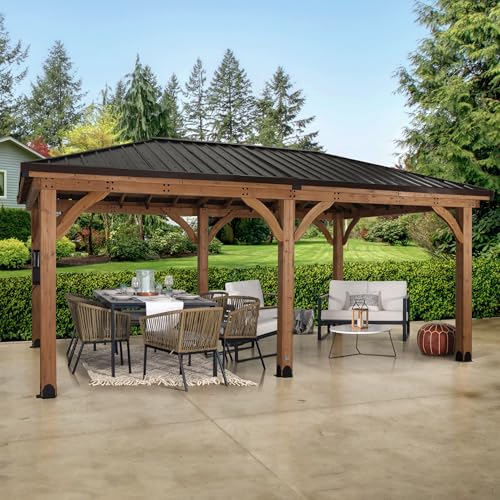
The Barrington 20x12 is the biggest gazebo on this site, and it tops our 2026 ranking because it combines size, a heavy steel roof, detailed anchoring guidance and a five-year warranty. It is a cedar-framed hip-roof structure from Backyard Discovery, sold both as a gazebo and as a carport. This page covers what the maker publishes, what that means in a backyard, and who should look at a smaller model instead.
We have not installed or used this structure ourselves. Everything below comes from Backyard Discovery’s official product page, its Barrington 20x12 owner’s manual and its general information booklet, and the analysis is ours. Where a number is missing from those sources, we leave it out.
What Backyard Discovery Says
According to Backyard Discovery, the Barrington 20x12 has:
- A heavy-gauge steel hip roof. The page specifies a 29-gauge Tudor Brown galvanized steel roof that the maker says resists dents and corrosion.
- A cedar frame. The company describes 100% cedar wood with natural resistance to decay, with 6 x 6 inch cedar posts.
- Pre-cut, pre-drilled, pre-stained parts. The finish is a light brown stain, and the page notes that stain saturation may vary from piece to piece.
- Powder-coated steel brackets and anchors for added weather resistance.
- PowerPort. A patented outlet module with three 120V outlets and three USB ports that mounts on any post. The power source is not included.
- Listed dimensions of 238.75 in. wide, 144.75 in. deep and 123.25 in. high, with a listed weight of 1,182.11 lb across eight shipping boxes.
The company also sells optional add-ons for the Barrington line: assembly service, a custom-fit mosquito netting kit and a matching 5 inch aluminum gutter kit.
At roughly 20 by 12 feet, the Barrington covers about 240 square feet. That is enough for a full outdoor living room: a sectional and coffee table at one end, a dining table at the other, or a conversation set with room left to walk around. Backyard Discovery’s description mentions comfortable furniture, a private retreat, a space for yoga or exercise, and backyard parties.
Keep in mind that the listed 20 by 12 feet describes the structure, and the usable floor under the roof is a little smaller once posts and rails are accounted for. Mark the layout on the ground with chalk or tape first, and leave extra room around it.
If you are thinking of placing a hot tub under it, check your tub’s dimensions, the clearance between the tub cover and the roof structure, and the tub maker’s own placement instructions before you buy. We found no statement from Backyard Discovery about hot tubs, so we make no claim about that use.
Roof and Frame
The hip roof slopes on all four sides, which is the classic gazebo profile and sheds rain and snow evenly. The steel panels are what separate this model from softer-topped canopies. Backyard Discovery says the roof, along with the cedar posts and galvanized hardware, is part of its Pro-Tect program, and it rates the 20x12 for up to 12,700 pounds or 30 inches of snow load and winds up to 100 mph.
Read the fine print on that claim. Backyard Discovery’s page adds a condition: the product must be anchored as specified in the instruction manual. The same wording appears in the marketing text about wind. In other words, the numbers apply to a structure built and anchored per the manual, and they are the maker’s own figures. They are not a guarantee of how any gazebo will behave in a storm, and the National Weather Service notes that straight-line thunderstorm winds can exceed 100 mph and that high winds can blow objects around. If your area sees heavy snow, clear the roof of accumulation anyway, because no rating replaces good judgment.
Anchoring and Site Prep
This is where the manual earns its keep. It says it is critically important to start with square and level footings, a concrete pad or a deck. Post mounts come with the gazebo so that you can install it permanently on a wood or concrete surface, and the manual shows four anchors per post on metal anchor plates.
The important details, from the manual:
- Hardware to attach the post mounts to the structure is included.
- Hardware to mount the structure permanently to a concrete surface is included (the parts list includes concrete anchors).
- Hardware to mount it to a wood deck is not included and must be purchased separately.
- You must ensure ample structural support under a deck before attaching.
- Check for underground utilities and overhead electrical lines before you start.
For a deck, that last point matters a lot. A structure of this size adds real weight and uplift loads. Ask a licensed contractor to confirm that your deck framing can take it, and check local permit and homeowners association rules before you order. Backyard Discovery’s warranty also states that installation that does not follow the assembly instructions voids it, and that it does not cover installation on uneven, unlevel or soft ground.
Power and Lighting
PowerPort is the feature buyers ask about most. The module mounts on any post, and the manual says to follow the instructions packaged with the PowerPort kit. It does not turn the gazebo into a wired room by itself, and the page says the power source is not included. Bringing electricity out to the structure, adding outdoor-rated outlets or hanging fixed lighting should be done by a licensed electrician, who will handle ground-fault protection and local code. Do not rely on indoor extension cords across a lawn.
The manual also shows an optional fan mount bracket for the ridge beams, with the electrical box sold separately, which suggests how the maker expects owners to use the space.
Assembly
Backyard Discovery points owners to its BILT app for 3D interactive instructions, and the pieces arrive pre-cut, pre-drilled and pre-stained. That removes some work, but this is still a big project by the numbers: eight boxes, the heaviest listed at about 161 lb, and a listed total weight of 1,182 lb. Read the “What to Expect” guide the company links to, line up helpers, and consider the paid assembly service if you do not have the time. The structure should be assembled on a prepared, level base with the manual open to the hardware list for each step, since the manual warns that using incorrect hardware may result in improper assembly.
Maintenance and Warranty
Cedar resists decay but it is still wood. Backyard Discovery says the product may require a sealant that is not included, and that you should read your manual to see whether it does. Its limited warranty for patio structures lasts five years from the original purchase, is non-transferable, and requires regular maintenance. It does not cover natural wood behavior such as twisting, warping, checking or peeling, cosmetic problems such as rust or color fading, or damage from storms and excessive water. Keep your receipt and register the product if the maker offers it.
Who It Suits
- Large patios and slabs. If you have a 20 by 12 foot pad, this is the statement piece.
- Entertainers. The footprint holds seating and dining at the same time.
- Snowy regions. The maker rates it for 30 inches of snow when anchored per the manual, and 12,700 lb of roof load.
- Buyers who want a long warranty. Five years is the longest warranty among our picks.
Who Should Look Elsewhere
- Small yards. Consider the Barrington 12x12, which uses the same design at a smaller scale.
- Anyone who wants an eight-sided look. The Sunjoy Ion 13x13 octagon has a different shape, and its manual cautions against harsh weather.
- People who cannot anchor. The ratings only apply to an anchored structure.
- Anyone wanting low maintenance. Wood needs care.
Bottom Line
The Barrington 20x12 is a premium, roomy cedar gazebo with a steel roof, a published snow and wind rating tied to anchoring, concrete hardware in the box and a five-year warranty. Its drawbacks are size, weight, ongoing wood care and the extra work on a deck. The button below shows the current listing on Amazon. For the full lineup, see the best gazebos of 2026.
See price on Amazon
Sources